Getting Started with NNS: Overview
Fred Viole
Source:vignettes/NNSvignette_Overview.Rmd
NNSvignette_Overview.Rmd
# Prereqs (uncomment if needed):
# install.packages("NNS")
# install.packages(c("data.table","xts","zoo","Rfast"))

library(NNS)
## Warning in rgl.init(initValue, onlyNULL): RGL: unable to open X11 display## Warning: 'rgl.init' failed, will use the null device.
## See '?rgl.useNULL' for ways to avoid this warning.Orientation
Goal. A complete, hands‑on curriculum for Nonlinear Nonparametric Statistics (NNS) using partial moments. Each section blends narrative intuition, precise math, and executable code.
Structure. 1. Foundations — partial moments & variance decomposition 2. Descriptive & distributional tools 3. Dependence & nonlinear association 4. Normalization & Rescaling 5. Hypothesis testing, ANOVA & Stochastic Superiority 6. Regression, boosting, stacking & causality 7. Time series & forecasting 8. Simulation (max‑entropy) & Monte Carlo 9. Portfolio & stochastic dominance
Notation. For a random variable and threshold/target , the population ‑th partial moments are defined as:
The empirical estimators replace with the empirical CDF (or, equivalently, use indicator functions):
These correspond to integrals over the measurable subsets and in a ‑algebra; the empirical sums are discrete analogues of Lebesgue integrals.
1. Foundations — Partial Moments & Variance Decomposition
1.1 Why partial moments
- Classical variance treats upside and downside symmetrically. Partial moments separate them, allowing asymmetric risk/reward analysis around a chosen target (often the mean or a benchmark).
- At : This is not the same as splitting conditional variances around a threshold; partial moments use a global reference, preserving the between‑group contribution.
1.3 Code: variance decomposition & CDF
set.seed(42)

# Normal sample
y <- rnorm(3000)
mu <- mean(y)
L2 <- LPM(2, mu, y); U2 <- UPM(2, mu, y)
cat(sprintf("LPM2 + UPM2 = %.6f vs var(y)=%.6f\n", (L2+U2)*(length(y) / (length(y) - 1)), var(y)))
## LPM2 + UPM2 = 1.011889 vs var(y)=1.011889
# Empirical CDF via LPM.ratio(0, t, x)
for (t in c(-1,0,1)) {
  cdf_lpm <- LPM.ratio(0, t, y)
  cat(sprintf("CDF at t=%+.1f : LPM.ratio=%.4f | empirical=%.4f\n", t, cdf_lpm, mean(y<=t)))
}
## CDF at t=-1.0 : LPM.ratio=0.1633 | empirical=0.1633
## CDF at t=+0.0 : LPM.ratio=0.5043 | empirical=0.5043
## CDF at t=+1.0 : LPM.ratio=0.8480 | empirical=0.8480
# Asymmetry on a skewed distribution
z <- rexp(3000)-1; mu_z <- mean(z)
cat(sprintf("Skewed z: LPM2=%.4f, UPM2=%.4f (expect imbalance)\n", LPM(2,mu_z,z), UPM(2,mu_z,z)))
## Skewed z: LPM2=0.2780, UPM2=0.7682 (expect imbalance)Interpretation. The equality
LPM2 + UPM2 == var(x) (Bessel adjustment used) holds
because deviations are measured against the global mean.
LPM.ratio(0, t, x) constructs an empirical CDF directly
from partial‑moment counts.
2. Descriptive & Distributional Tools
2.1 Higher moments from partial moments
Define asymmetric analogues of skewness/kurtosis using , (and degree 4), yielding robust tail diagnostics without parametric assumptions.
Header.
NNS.moments(x)
M <- NNS.moments(y)
M
## $mean
## [1] -0.0114498
##
## $variance
## [1] 1.011552
##
## $skewness
## [1] -0.007412142
##
## $kurtosis
## [1] 0.067237722.3 CDF tables via LPM ratios
Headers.
-
LPM.ratio(degree = 0, target, variable)(empirical CDF whendegree=0) UPM.ratio(degree = 0, target, variable)-
LPM.VaR(p, degree, variable)(quantiles via partial‑moment CDFs) UPM.VaR(p, degree, variable)
qgrid <- LPM.VaR(seq(0.05,0.95,.1),0,z) # equivalent to quantile(z,probs = seq(0.05,0.95,by=0.1))
CDF_tbl <- data.table(threshold = as.numeric(qgrid), CDF = LPM.ratio(0,qgrid,z))
CDF_tbl
## threshold CDF
## <num> <num>
## 1: -0.94052127 0.05
## 2: -0.83748109 0.15
## 3: -0.71317882 0.25
## 4: -0.57443327 0.35
## 5: -0.41017671 0.45
## 6: -0.20424962 0.55
## 7: 0.06850182 0.65
## 8: 0.41462712 0.75
## 9: 0.94307172 0.85
## 10: 2.09633977 0.953. Dependence & Nonlinear Association
3.1 Why move beyond Pearson
Pearson captures linear monotone relationships. Many structures (U‑shapes, saturation, asymmetric tails) produce near‑zero despite strong dependence. Partial‑moment dependence metrics respond to such structure.
Headers.
-
Co.LPM(degree_lpm, x, y, target_x, target_y, degree_y)/Co.UPM(...)(co‑partial moments) PM.matrix(LPM_degree, UPM_degree, target=NULL, variable, pop_adj=TRUE)-
NNS.dep(x, y)(scalar dependence coefficient) NNS.copula(X, target=NULL, continuous=TRUE, plot=FALSE, independence.overlay=FALSE)
3.2 Code: nonlinear dependence
set.seed(1)
x <- runif(2000,-1,1)
y <- x^2 + rnorm(2000, sd=.05)
cat(sprintf("Pearson r = %.4f\n", cor(x,y)))
## Pearson r = 0.0006## NNS.dep = 0.7097
X <- data.frame(a=x, b=y, c=x*y + rnorm(2000, sd=.05))
pm <- PM.matrix(1, 1, target = "means", variable=X, pop_adj=TRUE)
pm
## $cupm
## a b c
## a 0.17384174 0.05668152 0.10450858
## b 0.05668152 0.05566363 0.04414923
## c 0.10450858 0.04414923 0.07529373
##
## $dupm
## a b c
## a 0.0000000000 0.05675501 0.0005598221
## b 0.0143108307 0.00000000 0.0036839026
## c 0.0004239566 0.04430691 0.0000000000
##
## $dlpm
## a b c
## a 0.0000000000 0.014310831 0.0004239566
## b 0.0567550147 0.000000000 0.0443069142
## c 0.0005598221 0.003683903 0.0000000000
##
## $clpm
## a b c
## a 0.16803827 0.014485430 0.102709867
## b 0.01448543 0.037120650 0.003051617
## c 0.10270987 0.003051617 0.074865823
##
## $cov.matrix
## a b c
## a 0.3418800141 0.0001011068 0.206234664
## b 0.0001011068 0.0927842833 -0.000789973
## c 0.2062346637 -0.0007899730 0.150159552
cop <- NNS.copula(X, continuous=TRUE, plot=FALSE)
cop
## [1] 0.56927853.3 Code: copula
# Data
set.seed(123); x = rnorm(100); y = rnorm(100); z = expand.grid(x, y)

# Plot
rgl::plot3d(z[,1], z[,2], Co.LPM(0, z[,1], z[,2], z[,1], z[,2]), col = "red")

# Uniform values
u_x = LPM.ratio(0, x, x); u_y = LPM.ratio(0, y, y); z = expand.grid(u_x, u_y)

# Plot
rgl::plot3d(z[,1], z[,2], Co.LPM(0, z[,1], z[,2], z[,1], z[,2]), col = "blue")
Interpretation. NNS.dep remains high
for curved relationships; PM.matrix collects co‑partial
moments across variables; NNS.copula summarizes
higher‑dimensional dependence using partial‑moment ratios. Copulas are
returned and evaluated via Co.LPM functions.
4. Normalization and Rescaling
NNS provides two main tools for scaling data while preserving rank structure and distributional shape. Both operate via deterministic affine transformations.
4.1 Normalization
NNS.norm() rescales variables to a common magnitude
while preserving distributional structure. The method can be
linear (all variables forced to have the same mean) or
nonlinear (using dependence weights to produce a more
nuanced scaling). In the nonlinear case, the degree of association
between variables influences the final normalized values.
Header.
NNS.norm(x, linear=TRUE, chart.type = NULL)
A <- rnorm(100, mean = 0, sd = 1)
B <- rnorm(100, mean = 0, sd = 5)
C <- rnorm(100, mean = 10, sd = 1)
D <- rnorm(100, mean = 10, sd = 10)

X <- data.frame(A, B, C, D)

# Linear scaling
lin_norm <- NNS.norm(X, linear = TRUE, chart.type=NULL, location=NULL)
Interpretation. NNS.norm() brings
variables to a common scale without distorting their distributional
shape. Linear mode equalizes means; nonlinear mode additionally weights
each variable by its dependence with others, so more correlated
variables exert greater influence on the final scaling.
4.2 Risk‑neutral rescale (pricing context)
NNS.rescale() performs one‑dimensional affine
transformations.
Header.
NNS.rescale(x, a, b, method=c("minmax","riskneutral"), T=NULL, type=c("Terminal","Discounted"))
px <- 100 + cumsum(rnorm(260, sd = 1))
rn <- NNS.rescale(px, a=100, b=0.03, method="riskneutral", T=1, type="Terminal")
c( target = 100*exp(0.03*1), mean_rn = mean(rn) )
## target mean_rn
## 103.0455 103.0455Interpretation. riskneutral shifts the
mean to match
(Terminal) or
(Discounted), preserving distributional shape.
5. Hypothesis Testing, ANOVA & Stochastic Superiority
5.1 Concept
Instead of distributional assumptions, compare groups via LPM‑based CDFs. Output is a degree of certainty (not a p‑value) for equality of populations or means.
Header.
NNS.ANOVA(control, treatment, means.only=FALSE, medians=FALSE, confidence.interval=.95, tails=c("Both","left","right"), pairwise=FALSE, plot=TRUE, robust=FALSE)NNS.SS(x, y, ...)
5.2 Code: two‑sample & multi‑group
ctrl <- rnorm(200, 0, 1)
trt  <- rnorm(180, 0.35, 1.2)
NNS.ANOVA(control=ctrl, treatment=trt, means.only=FALSE, plot=FALSE)
## $Control
## [1] 0.05568255
##
## $Treatment
## [1] 0.2771257
##
## $Grand_Statistic
## [1] 0.1605767
##
## $Control_CDF
## [1] 0.5670595
##
## $Treatment_CDF
## [1] 0.4385169
##
## $Certainty
## [1] 0.6905166
##
## $Effect_Size_LB
## 2.5%
## -0.07055716
##
## $Effect_Size_UB
## 97.5%
## 0.5317766
##
## $Confidence_Level
## [1] 0.95
A <- list(g1=rnorm(150,0.0,1.1), g2=rnorm(150,0.2,1.0), g3=rnorm(150,-0.1,0.9))
NNS.ANOVA(control=A, means.only=TRUE, plot=FALSE)
## Certainty
## 0.6876008Math sketch. For each quantile/threshold
,
compare CDFs built from LPM.ratio(0, t, •) (possibly with
one‑sided tails). Aggregate across
to a certainty score.
5.3 Stochastic Superiority
Stochastic superiority asks a different question than equality of means or equality of distributions. Rather than testing whether two samples came from the same population, or whether they share the same mean or median, stochastic superiority measures the probability that a random draw from one distribution exceeds a random draw from another.
For two random variables and , the stochastic superiority probability is:
and with ties accounted for, the tie-adjusted stochastic superiority measure is:
A value of indicates no directional advantage, values above favor , and values below favor .
This differs from stochastic dominance. Stochastic superiority is a pairwise exceedance probability, while stochastic dominance requires one distribution to be preferred to another over the entire shared support.
Below is an example comparing two distributions with unequal means.
## $p_gt
## [1] 0.233915
##
## $p_tie
## [1] 0
##
## $p_star
## [1] 0.233915
Since was generated with a higher mean, the stochastic superiority probability for relative to should be less than , indicating that a draw from is less likely to exceed a draw from .
We can also obtain confidence intervals for the tie-adjusted superiority probability using maximum entropy bootstrap replicates.
NNS.SS(x, y, confidence.interval = TRUE, reps = 999, ci = 0.95)[1:5]

$p_gt
[1] 0.233915

$p_tie
[1] 0

$p_star
[1] 0.233915

$lower
[1] 0.2105631

$upper
[1] 0.2537789
This provides an interpretable effect size for directional comparison between two distributions without requiring identical distributions or equal variances.
For discrete variables, ties may occur with positive probability, and
the reported p_tie and p_star values reflect
that adjustment explicitly.
set.seed(123)
x = sample(1:5, 100, replace = TRUE)
y = sample(1:5, 100, replace = TRUE)

NNS.SS(x, y)
## $p_gt
## [1] 0.3982
##
## $p_tie
## [1] 0.1992
##
## $p_star
## [1] 0.49786. Regression, Boosting, Stacking & Causality
6.1 Philosophy
NNS.reg learns partitioned
relationships using partial‑moment weights — linear where appropriate,
nonlinear where needed — avoiding fragile global parametric forms.
Headers.
-
NNS.reg(x, y, order=NULL, smooth=TRUE, ncores=1, ...)→$Fitted.xy,$Point.est, … NNS.boost(IVs.train, DV.train, IVs.test, epochs, learner.trials, status, balance, type, folds)NNS.stack(IVs.train, DV.train, IVs.test, type, balance, ncores, folds)-
NNS.caus(x, y)(directional causality score via conditional dependence)
6.2 Code: classification via regression + ensembles
# Example 1: Nonlinear regression
set.seed(123)
x_train <- runif(1000, -2, 2)
y_train <- sin(pi * x_train) + rnorm(1000, sd = 0.2)

x_test <- seq(-2, 2, length.out = 100)

NNS.reg(x = x_train, y = y_train, order = NULL, point.est = x_test)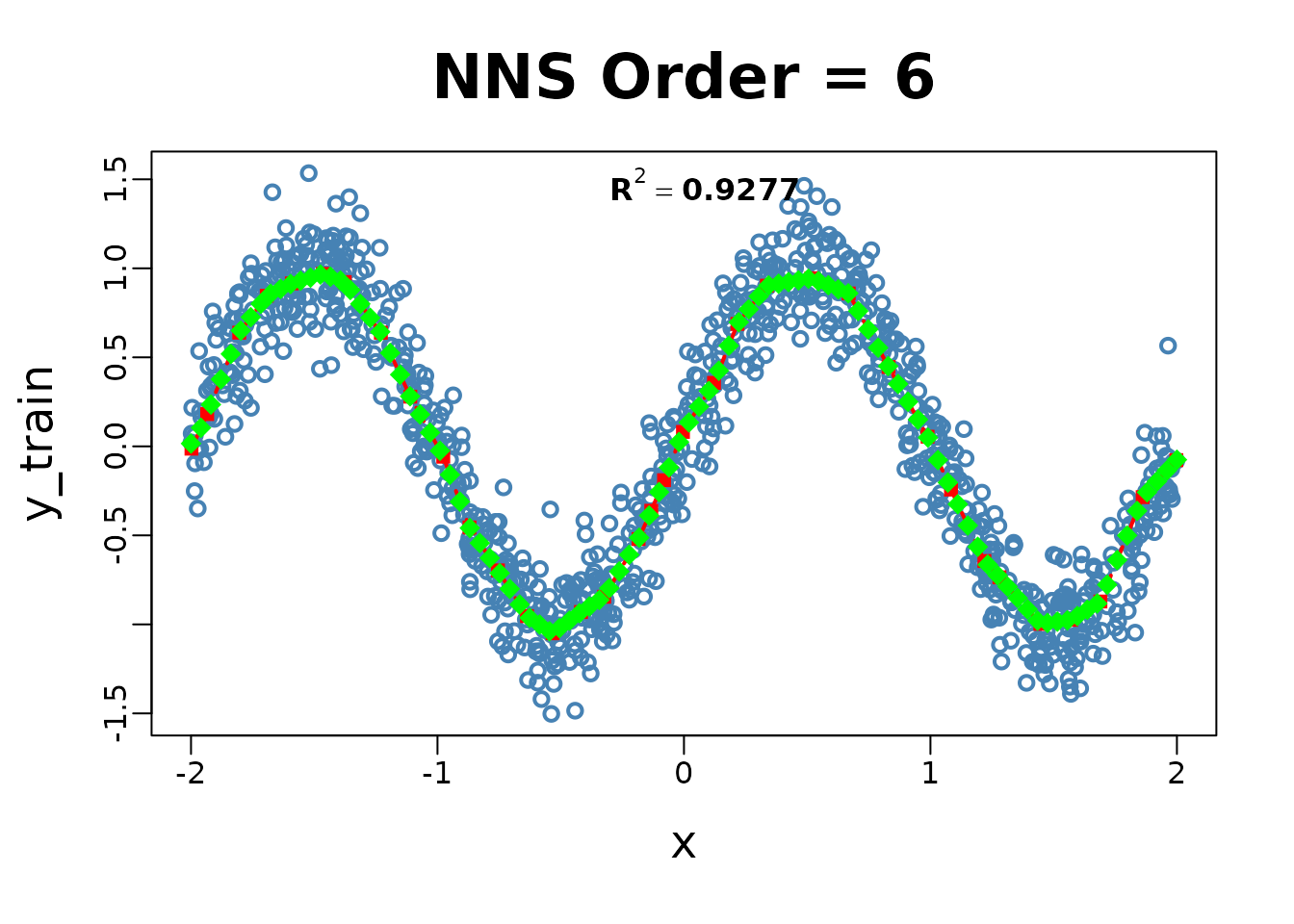
## $R2
## [1] 0.9276761
##
## $SE
## [1] 0.2015258
##
## $Prediction.Accuracy
## NULL
##
## $equation
## NULL
##
## $x.star
## NULL
##
## $derivative
##     Coefficient X.Lower.Range X.Upper.Range
##           <num>         <num>         <num>
##  1:   3.0485215  -1.998138604  -1.934370540
##  2:   3.5169373  -1.934370540  -1.804387149
##  3:   1.8605016  -1.804387149  -1.692769075
##  4:   0.6783073  -1.692769075  -1.590915710
##  5:   0.4272848  -1.590915710  -1.465816449
##  6:  -0.5144026  -1.465816449  -1.376464546
##  7:  -1.9381128  -1.376464546  -1.229726997
##  8:  -3.0106084  -1.229726997  -1.110428636
##  9:  -2.5210796  -1.110428636  -0.976623793
## 10:  -3.7347021  -0.976623793  -0.870193992
## 11:  -2.0861598  -0.870193992  -0.754706576
## 12:  -2.1796417  -0.754706576  -0.636846031
## 13:  -0.9300308  -0.636846031  -0.533099369
## 14:   1.0359249  -0.533099369  -0.417818767
## 15:   0.9115004  -0.417818767  -0.323764665
## 16:   2.3250859  -0.323764665  -0.184330858
## 17:   3.0769180  -0.184330858  -0.132632209
## 18:   3.3162510  -0.132632209  -0.080933560
## 19:   3.5323950  -0.080933560  -0.004108338
## 20:   2.1862481  -0.004108338   0.121863569
## 21:   3.4805229   0.121863569   0.216987038
## 22:   1.8001452   0.216987038   0.336388996
## 23:   0.2295375   0.336388996   0.516729182
## 24:  -0.5625172   0.516729182   0.668479078
## 25:  -2.5532272   0.668479078   0.830264570
## 26:  -2.4765129   0.830264570   0.988320504
## 27:  -3.1248612   0.988320504   1.083380900
## 28:  -2.9622550   1.083380900   1.218812429
## 29:  -1.5047059   1.218812429   1.279773569
## 30:  -1.5723118   1.279773569   1.445979675
## 31:   0.1804598   1.445979675   1.571628940
## 32:   0.8726461   1.571628940   1.689536565
## 33:   3.4198918   1.689536565   1.860999223
## 34:   1.5206901   1.860999223   1.997618112
##     Coefficient X.Lower.Range X.Upper.Range
##           <num>         <num>         <num>
##
## $Point.est
##   [1]  0.01571202  0.10442684  0.23470933  0.37680781  0.51890629  0.65039140
##   [7]  0.72556318  0.80073496  0.85698998  0.88439634  0.91180269  0.93033285
##  [13]  0.94759688  0.96486091  0.95248720  0.93170326  0.87827479  0.79996720
##  [19]  0.72165961  0.64335202  0.52449573  0.40285499  0.28121424  0.17901835
##  [25]  0.07715655 -0.02470525 -0.15949123 -0.31038828 -0.45880078 -0.54309006
##  [31] -0.62737935 -0.71234468 -0.80041101 -0.88847734 -0.96331853 -1.00089554
##  [37] -1.03847254 -1.02090671 -0.97905116 -0.93719561 -0.89956805 -0.86273975
##  [43] -0.79660165 -0.70265879 -0.60871593 -0.51288396 -0.38856404 -0.25667590
##  [49] -0.11829230  0.02443074  0.13442845  0.22276171  0.31109496  0.42473203
##  [55]  0.56535922  0.69718932  0.76992246  0.84265560  0.90432326  0.91359751
##  [61]  0.92287175  0.93214599  0.94142023  0.92794242  0.90521445  0.88248648
##  [67]  0.85975852  0.76020581  0.65704511  0.55388442  0.45072372  0.35051056
##  [73]  0.25044944  0.15038831  0.04930377 -0.07695325 -0.20321027 -0.32495818
##  [79] -0.44464525 -0.56433232 -0.66432673 -0.72512293 -0.78817431 -0.85170206
##  [85] -0.91522981 -0.97875756 -0.99186193 -0.98457062 -0.97727932 -0.95314667
##  [91] -0.91788824 -0.88262981 -0.77697785 -0.63880041 -0.50062296 -0.36244551
##  [97] -0.25805231 -0.19661029 -0.13516826 -0.07526941
##
## $pred.int
## NULL
##
## $regression.points
##                x           y
##            <num>       <num>
##  1: -1.998138604 -0.01307124
##  2: -1.934370540  0.18132707
##  3: -1.804387149  0.63847051
##  4: -1.692769075  0.84613612
##  5: -1.590915710  0.91522399
##  6: -1.465816449  0.96867700
##  7: -1.376464546  0.92271416
##  8: -1.229726997  0.63832023
##  9: -1.110428636  0.27915958
## 10: -0.976623793 -0.05817308
## 11: -0.870193992 -0.45565668
## 12: -0.754706576 -0.69658188
## 13: -0.636846031 -0.95347564
## 14: -0.533099369 -1.04996323
## 15: -0.417818767 -0.93054118
## 16: -0.323764665 -0.84481083
## 17: -0.184330858 -0.52061525
## 18: -0.132632209 -0.36154275
## 19: -0.080933560 -0.19009705
## 20: -0.004108338  0.08127998
## 21:  0.121863569  0.35668582
## 22:  0.216987038  0.68776523
## 23:  0.336388996  0.90270609
## 24:  0.516729182  0.94410093
## 25:  0.668479078  0.85873901
## 26:  0.830264570  0.44566388
## 27:  0.988320504  0.05423632
## 28:  1.083380900 -0.24281423
## 29:  1.218812429 -0.64399694
## 30:  1.279773569 -0.73572553
## 31:  1.445979675 -0.99705336
## 32:  1.571628940 -0.97437872
## 33:  1.689536565 -0.87148709
## 34:  1.860999223 -0.28510334
## 35:  1.997618112 -0.07734835
##                x           y
##            <num>       <num>
##
## $Fitted.xy
##                x          y      y.hat  NNS.ID   gradient    residuals
##            <num>      <num>      <num>  <char>      <num>        <num>
##    1: -0.8496899 -0.5752368 -0.4984314 q121122 -2.0861598  0.076805376
##    2:  1.1532205 -0.6617217 -0.4496971 q221122 -2.9622550  0.212024652
##    3: -0.3640923 -0.7048691 -0.8815695 q122122  0.9115004 -0.176700402
##    4:  1.5320696 -0.8447168 -0.9815176 q222121  0.1804598 -0.136800802
##    5:  1.7618691 -0.9820881 -0.6241175 q222212  3.4198918  0.357970569
##   ---
##  996:  1.3184955 -0.7988901 -0.7966085 q221222 -1.5723118  0.002281548
##  997:  0.5684553  1.1554781  0.9150041 q212122 -0.5625172 -0.240473993
##  998: -0.4340050 -0.7748325 -0.9473089 q122121  1.0359249 -0.172476359
##  999:  0.8383194  0.7041960  0.4257159 q212222 -2.4765129 -0.278480031
## 1000: -1.5647037  0.9467853  0.9264240 q111222  0.4272848 -0.020361366
##       standard.errors
##                 <num>
##    1:       0.1769692
##    2:       0.1783713
##    3:       0.1905081
##    4:       0.2044300
##    5:       0.2636784
##   ---
##  996:       0.1971693
##  997:       0.2137362
##  998:       0.1831159
##  999:       0.2108312
## 1000:       0.2078031
# Simple train/test for boosting & stacking
test.set = 141:150

boost <- NNS.boost(IVs.train = iris[-test.set, 1:4],
              DV.train = iris[-test.set, 5],
              IVs.test = iris[test.set, 1:4],
              epochs = 10, learner.trials = 10,
              status = FALSE, balance = TRUE,
              type = "CLASS", folds = 5)


mean(boost$results == as.numeric(iris[test.set,5]))
# [1] 1


boost$feature.weights; boost$feature.frequency

stacked <- NNS.stack(IVs.train = iris[-test.set, 1:4],
                     DV.train = iris[-test.set, 5],
                     IVs.test = iris[test.set, 1:4],
                     type = "CLASS", balance = TRUE,
                     ncores = 1, folds = 1)
mean(stacked$stack == as.numeric(iris[test.set,5]))
# [1] 1
6.3 Code: directional causality
NNS.caus(mtcars$hp, mtcars$mpg) # hp -> mpg## Causation.x.given.y Causation.y.given.x C(x--->y)
## 0.2607148 0.3863580 0.3933374
NNS.caus(mtcars$mpg, mtcars$hp) # hp -> mpg## Causation.x.given.y Causation.y.given.x C(y--->x)
## 0.3863580 0.2607148 0.3933374Interpretation. Examine asymmetry in scores to infer direction. The method conditions partial‑moment dependence on candidate drivers.
7. Time Series & Forecasting
Headers.
NNS.ARMANNS.ARMA.optimNNS.seasNNS.VAR
# Univariate nonlinear ARMA
z <- as.numeric(scale(sin(1:480/8) + rnorm(480, sd=.35)))

# Seasonality detection (prints a summary)
seasonal_period <- NNS.seas(z, plot = FALSE)
head(seasonal_period$all.periods)
## Period Coefficient.of.Variation Variable.Coefficient.of.Variation
## 1 200 0.4267885 8.540159e+16
## 2 96 0.4425880 8.540159e+16
## 3 49 0.4615546 8.540159e+16
## 4 198 0.4812956 8.540159e+16
## 5 199 0.4885608 8.540159e+16
## 6 146 0.4901054 8.540159e+16
# Validate seasonal periods
NNS.ARMA.optim(z, h = 48, seasonal.factor = seasonal_period$periods, plot = TRUE, ncores = 1)
## [1] "CURRNET METHOD: lin"
## [1] "COPY LATEST PARAMETERS DIRECTLY FOR NNS.ARMA() IF ERROR:"
## [1] "NNS.ARMA(... method = 'lin' , seasonal.factor = c( 51 ) ...)"
## [1] "CURRENT lin OBJECTIVE FUNCTION = 0.398327414917885"
## [1] "BEST method = 'lin', seasonal.factor = c( 51 )"
## [1] "BEST lin OBJECTIVE FUNCTION = 0.398327414917885"
## [1] "CURRNET METHOD: nonlin"
## [1] "COPY LATEST PARAMETERS DIRECTLY FOR NNS.ARMA() IF ERROR:"
## [1] "NNS.ARMA(... method = 'nonlin' , seasonal.factor = c( 51 ) ...)"
## [1] "CURRENT nonlin OBJECTIVE FUNCTION = 2.75408671013046"
## [1] "BEST method = 'nonlin' PATH MEMBER = c( 51 )"
## [1] "BEST nonlin OBJECTIVE FUNCTION = 2.75408671013046"
## [1] "CURRNET METHOD: both"
## [1] "COPY LATEST PARAMETERS DIRECTLY FOR NNS.ARMA() IF ERROR:"
## [1] "NNS.ARMA(... method = 'both' , seasonal.factor = c( 51 ) ...)"
## [1] "CURRENT both OBJECTIVE FUNCTION = 0.778172239627562"
## [1] "BEST method = 'both' PATH MEMBER = c( 51 )"
## [1] "BEST both OBJECTIVE FUNCTION = 0.778172239627562"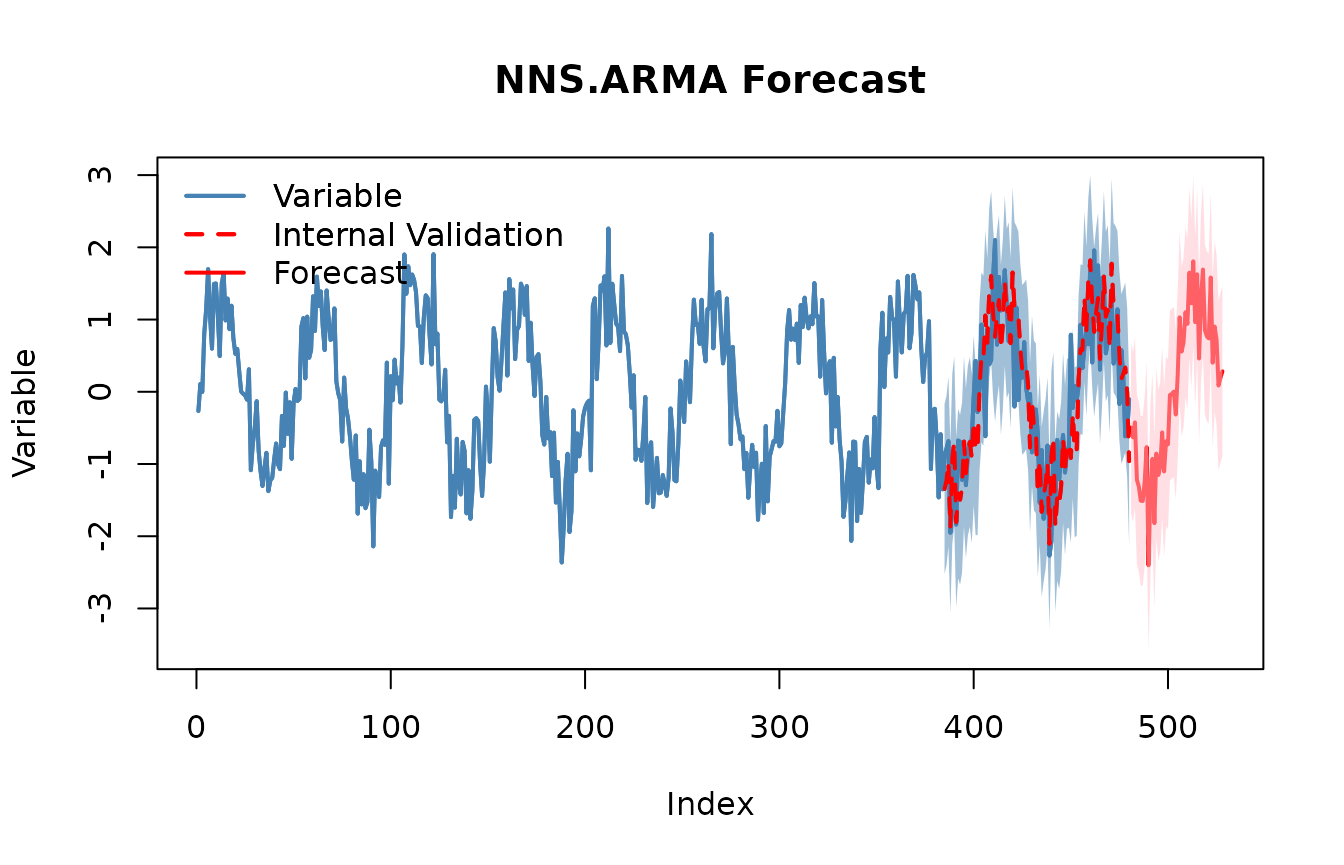
## $periods
## [1] 51
##
## $weights
## NULL
##
## $obj.fn
## [1] 0.3983274
##
## $method
## [1] "lin"
##
## $shrink
## [1] FALSE
##
## $nns.regress
## [1] FALSE
##
## $bias.shift
## [1] 0.01738357
##
## $errors
##  [1] -0.4754897523 -0.4609730867 -0.3018876142  0.0439513384 -0.1128600832
##  [6]  0.9193835234  0.0160010547 -0.7516578805 -0.8195384972 -0.1274709629
## [11] -0.0093477175  0.1480424491  0.0345888303  0.0009331215 -0.2819915138
## [16] -0.3474821395 -1.2543849202 -0.5442948705 -0.0049610072 -0.4702036102
## [21]  0.1846614137  1.6541950586 -0.2046795992  0.9691745476  1.1460606178
## [26] -0.5141738440 -1.3562787956  0.3853973272 -0.3364881552 -0.5604890777
## [31] -0.3175309175 -0.1677932189 -0.1511705981  0.4541183441 -0.1377055180
## [36]  0.4279932502  1.3576081283 -0.0645315976  1.1430476887  0.1399600873
## [41]  0.0874395694 -0.3703494531  0.3046994756  0.2057574931 -0.7602832912
## [46]  0.6902933417  0.2238850985 -0.2775974238 -0.8250763050  0.5817787408
## [51] -0.8733350647  0.2906911996  0.1863210948 -0.2484232855  0.1444232735
## [56]  1.1655644133  0.0821221969 -0.2813315730 -0.7959981329 -0.3601165470
## [61] -0.4617740020 -0.0593491905  0.0143389607  0.1016580238  0.0300275332
## [66] -1.7237406556 -0.0930802461 -0.9348574200 -0.7189682901  0.0700766333
## [71] -0.3547205444  0.2333233909  0.6840012123 -0.0779445509  0.8409902584
## [76]  0.0130711684  0.8074727217 -1.1462424589  0.0926963526 -0.4674150054
## [81]  0.1308248298 -0.6493713604  0.0713668583  0.4889233461  0.4293197750
## [86] -0.4397639878  0.4261287370  0.7556075116  0.6016698079 -0.1086690282
## [91]  0.6426872057 -0.4175612763  0.0250816728  0.9344147185  0.5444153587
## [96] -0.8746369897
##
## $results
##  [1] -0.495145166 -0.629911085 -0.423647703 -1.217211533 -1.313660334
##  [6] -1.507558621 -1.512809568 -1.244102492 -0.765300445 -2.402307464
## [11] -1.325990243 -0.928756118 -1.819067479 -0.855732188 -1.152690586
## [16] -1.039006594 -0.562011496 -1.103503510 -0.685097085 -0.727417601
## [21] -0.044018500 -0.030435409  0.002633325 -0.314902491  0.232587264
## [26]  1.030889038  0.556722546  0.680351082  1.101193382  0.941245213
## [31]  1.648626820  1.225992916  1.806473740  0.964372963  1.627354696
## [36]  0.460925955  1.318674310  1.692295367  0.854538440  0.768654797
## [41]  0.739228654  1.582319086  0.402156303  0.902802567  0.718513288
## [46]  0.086635865  0.193748286  0.283357285
##
## $lower.pred.int
##  [1] -1.67077922 -1.80554514 -1.59928176 -2.39284559 -2.48929439 -2.68319268
##  [7] -2.68844363 -2.41973655 -1.94093450 -3.57794152 -2.50162430 -2.10439018
## [13] -2.99470154 -2.03136624 -2.32832464 -2.21464065 -1.73764555 -2.27913757
## [19] -1.86073114 -1.90305166 -1.21965256 -1.20606947 -1.17300073 -1.49053655
## [25] -0.94304679 -0.14474502 -0.61891151 -0.49528298 -0.07444068 -0.23438884
## [31]  0.47299276  0.05035886  0.63083968 -0.21126109  0.45172064 -0.71470810
## [37]  0.14304025  0.51666131 -0.32109562 -0.40697926 -0.43640540  0.40668503
## [43] -0.77347775 -0.27283149 -0.45712077 -1.08899819 -0.98188577 -0.89227677
##
## $upper.pred.int
##  [1]  0.68048889  0.54572297  0.75198635 -0.04157748 -0.13802628 -0.33192456
##  [7] -0.33717551 -0.06846843  0.41033361 -1.22667341 -0.15035619  0.24687794
## [13] -0.64343342  0.31990187  0.02294347  0.13662746  0.61362256  0.07213055
## [19]  0.49053697  0.44821646  1.13161556  1.14519865  1.17826738  0.86073157
## [25]  1.40822132  2.20652310  1.73235660  1.85598514  2.27682744  2.11687927
## [31]  2.82426088  2.40162697  2.98210780  2.14000702  2.80298875  1.63656001
## [37]  2.49430837  2.86792942  2.03017250  1.94428885  1.91486271  2.75795314
## [43]  1.57779036  2.07843662  1.89414735  1.26226992  1.36938234  1.45899134
Notes. NNS seasonality uses coefficient of variation instead of ACF/PACFs, and NNS ARMA blends multiple seasonal periods into the linear or nonlinear regression forecasts.
8. Simulation & Bootstrap & Risk‑Neutral Rescaling
8.1 Maximum entropy bootstrap (shape‑preserving)
Header.
NNS.meboot(x, reps=999, rho=NULL, type="spearman", drift=TRUE, ...)
x_ts <- cumsum(rnorm(350, sd=.7))
mb <- NNS.meboot(x_ts, reps=5, rho = 1)
dim(mb["replicates", ]$replicates)
## [1] 350 58.2 Monte Carlo over the full correlation space
Header.
NNS.MC(x, reps=30, lower_rho=-1, upper_rho=1, by=.01, exp=1, type="spearman", ...)
mc <- NNS.MC(x_ts, reps=5, lower_rho=-1, upper_rho=1, by=.5, exp=1)
length(mc$ensemble); names(mc$replicates)
## [1] 350## [1] "rho = 1" "rho = 0.5" "rho = 0" "rho = -0.5" "rho = -1"
head(mc$replicates$`rho = 0`)## Replicate 1 Replicate 2 Replicate 3 Replicate 4 Replicate 5
## [1,] 8.561720 11.097841 12.140974 3.478574 16.25845
## [2,] 4.989649 9.142348 6.298598 2.573488 11.23749
## [3,] 5.489892 11.635826 9.151404 4.146175 13.61840
## [4,] 7.175210 13.194315 11.614209 5.906763 19.23707
## [5,] 8.443500 12.157572 13.263425 4.369562 13.40513
## [6,] 7.386515 10.979258 11.705842 2.410838 15.311339. Portfolio & Stochastic Dominance
Stochastic dominance orders uncertain prospects for broad classes of risk‑averse utilities; partial moments supply practical, nonparametric estimators.
Headers.
NNS.FSD.uni(x, y)NNS.SSD.uni(x, y)NNS.TSD.uni(x, y)NNS.SD.cluster(R)NNS.SD.efficient.set(R)
RA <- rnorm(240, 0.005, 0.03)
RB <- rnorm(240, 0.003, 0.02)
RC <- rnorm(240, 0.006, 0.04)

NNS.FSD.uni(RA, RB)
## [1] 0
NNS.SSD.uni(RA, RB)## [1] 0
NNS.TSD.uni(RA, RB)## [1] 0
Rmat <- cbind(A=RA, B=RB, C=RC)
try(NNS.SD.cluster(Rmat, degree = 1))
## $Clusters
## $Clusters$Cluster_1
## [1] "C" "A" "B"
try(NNS.SD.efficient.set(Rmat, degree = 1))## Checking 1 of 2Checking 2 of 2## [1] "C" "A" "B"Appendix A — Measure‑theoretic sketch (why partial moments are rigorous)
Let be a probability space, measurable. For any fixed , the sets and are in because they are preimages of Borel sets. The population partial moments are
The empirical versions correspond to replacing with the empirical measure (or CDF ):
Centering at yields the variance decomposition identity in Section 1.
Appendix B — Quick Reference (Grouped by Topic)
1. Partial Moments & Ratios
-
LPM(degree, target, variable)— lower partial moment of orderdegreeattarget. -
UPM(degree, target, variable)— upper partial moment of orderdegreeattarget. -
LPM.ratio(degree, target, variable);UPM.ratio(...)— normalized shares;degree=0gives CDF. -
LPM.VaR(p, degree, variable)— partial-moment quantile at probabilityp. -
Co.LPM(degree_lpm, x, y, target_x, target_y, degree_y)— co-lower partial moment between two variables. -
Co.UPM(degree_upm, x, y, target_x, target_y, degree_y)— co-upper partial moment between two variables. -
D.LPM(degree, target, variable)— divergent lower partial moment (away fromtarget). -
D.UPM(degree, target, variable)— divergent upper partial moment (away fromtarget). -
NNS.CDF(x, target = NULL, points = NULL, plot = TRUE/FALSE)— CDF from partial moments. -
NNS.moments(x)— mean/var/skew/kurtosis via partial moments.
2. Descriptive Statistics & Distributions
-
NNS.mode(x, multi = FALSE)— nonparametric mode(s). -
PM.matrix(l_degree, u_degree, target, variable, pop_adj)— co-/divergent partial-moment matrices. -
NNS.gravity(x, w = NULL)— partial-moment weighted location (gravity center).
See NNS Vignette: Getting Started with NNS: Partial Moments
3. Dependence & Association
-
NNS.dep(x, y)— nonlinear dependence coefficient. -
NNS.copula(X, target, continuous, plot, independence.overlay)— dependence from co-partial moments.
See NNS Vignette: Getting Started with NNS: Correlation and Dependence
4. Normalization & Rescaling
-
NNS.norm(x, linear=FALSE)— normalization retaining target moments. -
NNS.rescale(x, a, b, method=c("minmax","riskneutral"), T=NULL, type=c("Terminal","Discounted"))— risk-neutral or min–max rescaling.
See NNS Vignette: Getting Started with NNS: Normalization and Rescaling
5. Hypothesis Testing
-
NNS.ANOVA(control, treatment, ...)— certainty of equality (distributions or means). -
NNS.SS(x, y, ...)— stochastic superiority between two variables.
See NNS Vignette: Getting Started with NNS: Comparing Distributions
6. Regression, Classification & Causality
-
NNS.part(x, y, ...)— partition analysis for variable segmentation. -
NNS.reg(x, y, ...)— partition-based regression/classification ($Fitted.xy,$Point.est). -
NNS.boost(IVs, DV, ...),NNS.stack(IVs, DV, ...)— ensembles usingNNS.regbase learners. -
NNS.caus(x, y)— directional causality score.
See NNS Vignette: Getting Started with NNS: Clustering and Regression
See NNS Vignette: Getting Started with NNS: Classification
7. Differentiation & Slope Measures
-
dy.dx(x, y)— numerical derivative ofywith respect toxviaNNS.reg. -
dy.d_(x, Y, var)— partial derivative of multivariateYw.r.t.var. -
NNS.diff(x, y)— derivative via secant projections.
8. Time Series & Forecasting
-
NNS.ARMA(...),NNS.ARMA.optim(...)— nonlinear ARMA modeling. -
NNS.seas(...)— detect seasonality. -
NNS.VAR(...)— nonlinear VAR modeling. -
NNS.nowcast(x, h, ...)— near-term nonlinear forecast.
See NNS Vignette: Getting Started with NNS: Forecasting
9. Simulation & Bootstrap
-
NNS.meboot(...)— maximum entropy bootstrap. -
NNS.MC(...)— Monte Carlo over correlation space.
See NNS Vignette: Getting Started with NNS: Sampling and Simulation
10. Portfolio Analysis & Stochastic Dominance
-
NNS.FSD.uni(x, y),NNS.SSD.uni(x, y),NNS.TSD.uni(x, y)— univariate stochastic dominance tests. -
NNS.SD.cluster(R),NNS.SD.efficient.set(R)— dominance-based portfolio sets.
For complete references, please see the Vignettes linked above and their specific referenced materials.